Despite recent advances in deep generative modeling, skin lesion classification systems remain constrained by
the limited availability of large, diverse, and well-annotated clinical datasets, resulting in class imbalance
between benign and malignant lesions and consequently reduced generalization performance.
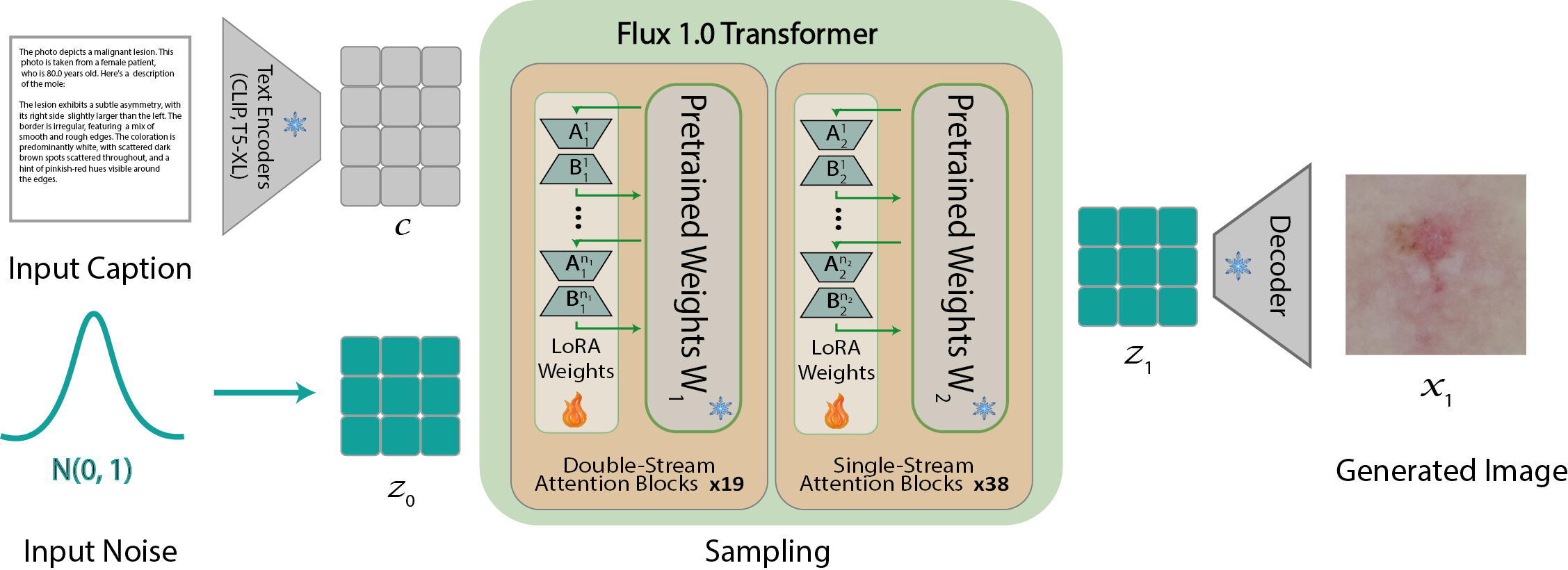
We introduce DermaFlux, a rectified flow-based text-to-image generative framework that synthesizes clinically
grounded skin lesion images from natural language descriptions of dermatological attributes.
Built upon Flux.1, DermaFlux is fine-tuned using parameter-efficient Low-Rank Adaptation (LoRA) on a large curated
collection of publicly available clinical image datasets. We construct image-text pairs using synthetic textual
captions generated by Llama 3.2, following established dermatological criteria including lesion asymmetry, border
irregularity, and color variation. Extensive experiments demonstrate that DermaFlux generates diverse and
clinically meaningful dermatology images that improve binary classification performance by up to 6% when augmenting
small real-world datasets, and by up to 9% when classifiers are trained on DermaFlux-generated synthetic images rather
than diffusion-based synthetic images. Our ImageNet-pretrained ViT fine-tuned with only 2,500 real images and 4,375
DermaFlux-generated samples achieves 78.04% binary classification accuracy and an AUC of 0.859, surpassing the next
best dermatology model by 8%.